


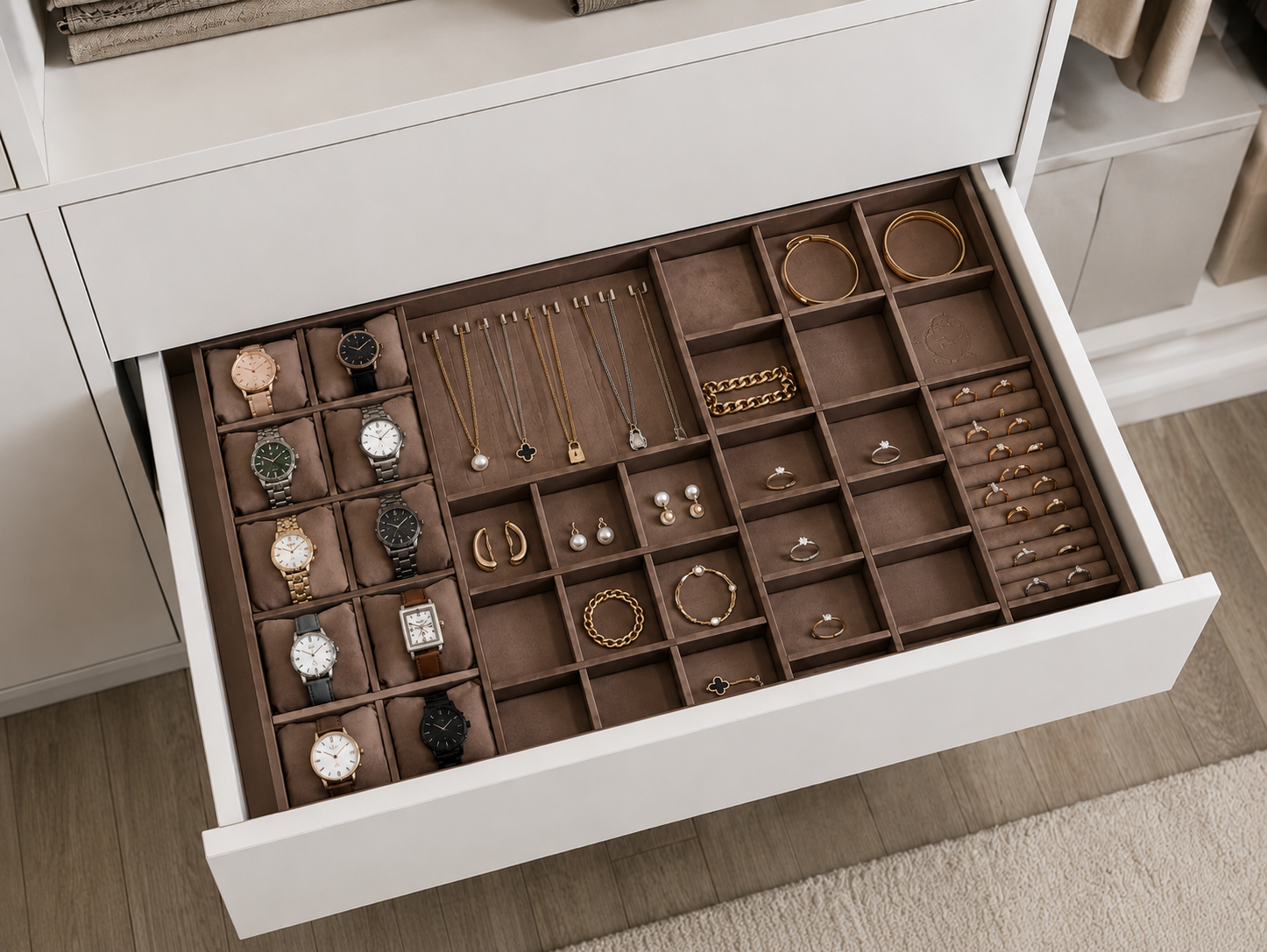
A jewellery drawer can become crowded faster than you expect. Rings pile up, earrings lose their pairs, and necklaces end up tangled together.
The problem is often not the amount of jewellery you own. It is the way each piece is stored.
A jewellery organiser should fit your collection, available space and daily routine. A person with ten pairs of earrings needs a different setup from someone with several necklaces and bangles.
Before buying one, look at what you own and how you use it. Then choose the storage layout that makes sense for your collection.
Start with what you actually own
Take a quick look through your jewellery before choosing an organiser. Separate everything into a few simple groups.
You might have rings, earrings, necklaces, bracelets, bangles and jewellery sets. Some collections may also include watches or larger statement pieces.
Counting each group can reveal what your organiser actually needs.
A collection with many rings benefits from several small sections. Someone with long necklaces needs more open space for those pieces. A bangle-heavy collection needs wider compartments that do not force pieces into tight slots.
Mixed collections need more flexibility. Small earrings should not share one large compartment with chunky bracelets.
This is why the number of compartments alone does not tell you whether an organiser will work. The size and layout of those compartments matter just as much.
Look at your most common jewellery types first. Your organiser should give those pieces enough room without leaving large areas unused.
If you have a mixed collection, jewellery trays with different compartment layouts can help separate smaller pieces from larger accessories.
Different jewellery pieces create different storage problems. The right jewellery organiser gives each category enough room to stay visible and separated.
Which Jewellery Organiser Is Right for Your Collection?
| Your jewellery collection | What you need | Organiser type to consider |
|---|---|---|
| Mostly rings | Small individual sections | Ring organiser tray |
| Mostly earrings | Small, separated compartments | Earring jewellery tray |
| Lots of necklaces | Longer, separated storage | Necklace jewellery tray |
| Bangles and bracelets | Wider compartments | Bangle or bracelet tray |
| Mixed jewellery | Different compartment sizes | Multi-section jewellery organiser |
| Jewellery kept in a drawer | Low-profile storage | Jewellery drawer organiser |
| Large or growing collection | More capacity and flexibility | Multi-tray jewellery organiser |
| Bridal or occasion jewellery | Larger sections for sets | Large jewellery organiser box |
| Custom-sized drawer | Exact dimensions | Custom jewellery organiser |
Rings need smaller sections
Rings can disappear quickly when several pieces sit together. Individual slots or narrow compartments keep them separated and easier to browse.
This setup also lets you see more of your collection at once. You can compare pieces without moving everything around.
Earrings need pair-friendly storage
Earrings are small, so they can easily get mixed together. Dedicated sections help keep pairs together and make individual pieces easier to find.
If you own many earrings, look for an organiser with enough smaller compartments. A few large sections may leave too much unused space.
Necklaces need room to spread out
Long necklaces need more attention because chains can tangle when they are packed together.
Choose a layout that gives necklaces enough length and separation. Avoid forcing longer pieces into shallow compartments that make them bend or overlap.
If necklaces make up most of your collection, this should influence your choice more than the organiser's overall appearance.
Wider compartments or a dedicated bangle organiser can give these pieces more breathing room.
Bangles can take up more room than smaller jewellery. Stacking several pieces into one narrow section can make them difficult to remove.
Wider compartments or trays give these pieces more breathing room. They also make it easier to see different colours, finishes and designs.
Jewellery sets need their own space
Matching earrings, necklaces and bracelets are easier to manage when they stay together.
A larger compartment can hold a complete set without forcing each piece into a different section. This can also save time when you are dressing for an occasion.
The goal is simple. Your jewellery storage organiser should make each type of jewellery easier to find, use and put away.
If your drawer has unusual dimensions, a custom jewellery drawer organiser can be planned around the available space.
Your available space can change the type of jewellery organiser you need.
A dresser allows more vertical space. If your jewellery lives inside a larger wardrobe system, wardrobe drawer organisers can help you create separate storage zones.
Measure the space before buying anything.
Check the drawer's width, depth and usable height. Do not measure only the outside of the furniture. Internal edges, rails and handles can reduce the actual storage area.
A shallow jewellery tray can work well inside a drawer because it uses horizontal space without taking up extra height.
A jewellery organiser box may suit a dresser or shelf where you want the collection contained in one place.
Think about visibility too. Open trays make everyday pieces easy to see. Enclosed storage can keep the collection less exposed when you do not access it often.
The best jewellery organiser for a drawer is not necessarily the largest one available. It is the one that fits the space while giving your collection enough room.
Decide how often you reach for each piece
Your daily routine should influence the organiser's layout.
Some jewellery gets worn almost every day. Other pieces may only come out for weddings, festivals, parties or special occasions.
Keep everyday pieces in the easiest-to-reach sections. You should not have to move five other items just to find the earrings you wear each morning.
Less frequently used jewellery can sit in deeper or less accessible sections. This creates a simple hierarchy inside your storage.
For example, you might keep your everyday rings and earrings in the front sections. Statement necklaces and occasion jewellery can sit behind them.
This small change can make your storage easier to use every day.
An organiser should save you time, not create another step in your routine.
Leave some room for the collection you will own later
Your jewellery collection may not stay the same size.
You might buy new earrings during a holiday, receive jewellery as a gift or add a few pieces for special occasions. An organiser that is already completely full leaves little room for those additions.
Avoid choosing storage based only on today's collection.
If you have ten empty slots today, that space may become useful later. It is often easier to add another tray or section than replace your entire storage setup.
Modular organisers can also help people whose collections change regularly. You can add or rearrange sections as your needs change.
Think of your current collection as the starting point.
A little spare capacity can keep your storage useful for longer.
Check the organiser before you buy it
Once you understand your collection and available space, look closely at the organiser itself.
Start with the compartment layout. Do the sections match the jewellery you actually own? Ten compartments are not useful if most of them are the wrong size.
Check the interior lining too. Jewellery can scratch or rub against hard surfaces when pieces are stored carelessly. A soft lining gives delicate pieces a more suitable surface.
Look at compartment depth. Larger pieces need enough room to sit comfortably without pressing against the organiser or other jewellery.
Then check the overall dimensions again. A beautiful jewellery organiser that does not fit your drawer will not solve the storage problem.
Finally, consider how it looks.
Your storage may sit inside a drawer, on a dresser or in a wardrobe. Choose a finish and design that works with the space you already have.
A good organiser should look right, but its layout should work right first.
What kind of jewellery organiser fits your collection
Your collection can point you toward the right format.
- Mostly rings and earrings: Choose an organiser with several smaller compartments and dedicated ring sections.
- Lots of necklaces: Look for layouts that give longer pieces enough space to stay separated.
- Bangles and chunky pieces: Choose wider compartments or a jewellery tray with more open storage.
- A mixed collection: Look for different compartment sizes instead of one uniform layout.
- Drawer storage: Choose a shallow organiser that matches your measured drawer dimensions.
- A growing collection: Consider modular or expandable storage that gives you room to add pieces later.
You do not need to find one organiser that does everything perfectly.
You need one that matches the jewellery you actually own.
A good organiser should make your collection easier to use
Choosing a jewellery organiser becomes much easier when you work through five questions.
What jewellery do you own? How much space does each type need? Where will you store it? Which pieces do you use most often? Will your collection grow?
Those answers can narrow your options quickly.
A jewellery tray may suit one collection, while a compartmentalised box may suit another. Someone with a large collection may need a more flexible setup.
La Trove offers different organiser formats designed around different storage needs. You can explore the collection and compare layouts based on your jewellery and available space.
Choose storage around the way you live
The right jewellery organiser does more than keep pieces in separate compartments. It makes your collection easier to see, reach and put away.
Start with your jewellery rather than the organiser. Then consider your space, daily routine and future needs.
Once those pieces fit together, choosing storage becomes much simpler.
Explore La Trove's jewellery organisers and find a layout that works for your collection.


Leave a comment
This site is protected by hCaptcha and the hCaptcha Privacy Policy and Terms of Service apply.