


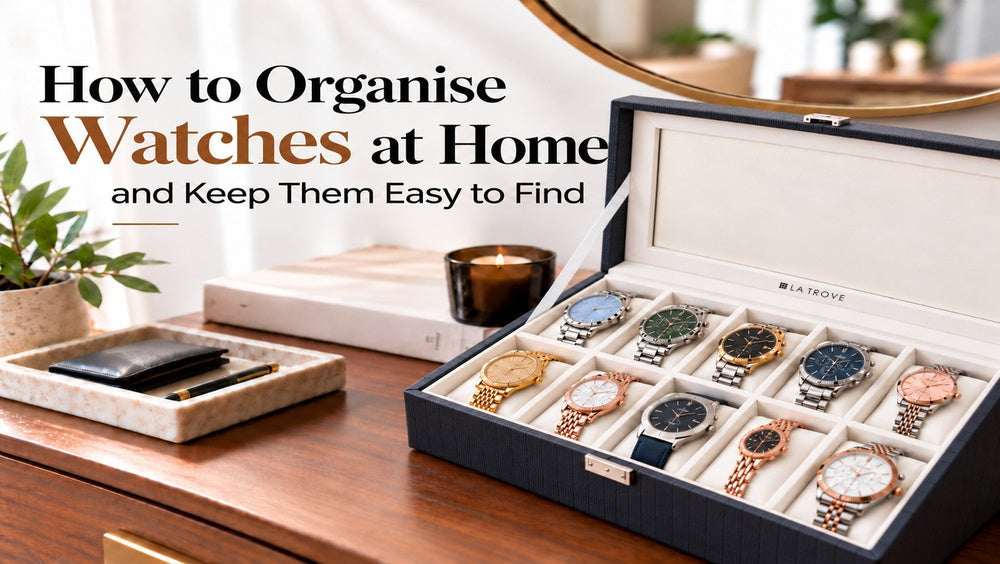
A watch can be easy to find in the morning and surprisingly difficult to locate the next day. It often happens when several watches share a drawer with spare straps, jewellery, and other accessories.
Learning how to organise watches can make your daily routine simpler. It also helps you keep your collection separated, visible, and easier to care for.
You do not need a large display cabinet or an elaborate storage system. A few thoughtful decisions about where you keep your watches, how you arrange them, and how you store them after wearing them can make a real difference.
Here is a practical way to organise your collection at home, whether you own two watches or several.
How to sort your watches before organising them
Before buying an organiser or rearranging a drawer, gather your watches in one place. Seeing the entire collection helps you understand how much storage you actually need.
Start by checking each watch for visible dirt, loose parts, or signs of damage. Set aside anything that needs attention before returning it to storage. Follow the manufacturer's care instructions when cleaning different watch materials.
Next, group your watches according to how you use them.
- Everyday watches: Keep the watches you wear most often in an easily accessible group.
- Work and formal watches: Separate dress watches that you prefer for meetings, events, or special occasions.
- Sports and casual watches: Group watches suited to exercise, outdoor activities, or relaxed outfits.
- Occasional watches: Store watches you rarely wear in suitable compartments where they remain protected.
Imagine owning four watches, including one for work, one for daily errands, one for formal occasions, and one for weekends. Grouping them by purpose makes it easier to choose the right watch without searching through the entire collection.
You can also organise by colour, strap type, or brand if those categories suit your habits better. The best system is the one you can maintain without extra effort.
How to choose the best place to store your watches
The right storage location depends on your home, your collection, and how often you wear each watch. A suitable setup should keep watches accessible while reducing exposure to dust, accidental knocks, and unsuitable conditions.
A wardrobe drawer works well when you want to keep watches alongside other accessories. A dressing table can be convenient if you choose your watch while getting ready. A dedicated watch box suits people who prefer an enclosed storage option.
A watch organiser tray is another practical choice, especially when you want separate compartments inside a drawer. It helps give each watch a defined place without requiring a large display cabinet.
Before choosing a location, check a few things.
- Available space: Measure the drawer or shelf so the organiser fits without obstructing its use.
- Accessibility: Choose a position where you can reach your watches without moving other belongings.
- Storage conditions: Prefer a dry, stable location away from direct sunlight and excessive heat.
- Protection: Avoid areas where watches can fall, become crushed, or come into contact with hard objects.
Bathrooms and damp areas are generally poor choices for long-term watch storage because humidity can affect some watch materials and components.
You should also consider your daily routine. Keeping frequently worn watches within easy reach makes the system more useful than storing everything in a difficult-to-access cupboard.
How to arrange watches so you can find them quickly
Once you have chosen a storage location, give every watch a consistent place. A clear arrangement saves time because you know where to look when you need a particular watch.
Start by placing your most frequently worn watches in the easiest-to-reach compartments. Keep formal or occasional watches in separate positions so you can find them without disturbing the rest of your collection.
You can organise the watches in several ways.
- By occasion: Keep work, everyday, formal, and casual watches in separate groups.
- By style: Place similar designs together if you often choose watches to match your outfits.
- By colour: Arrange watches by dial, case, or strap colour if that makes your collection easier to scan.
- By frequency of use: Give your regular favourites the most accessible positions.
For example, a six-watch collection could have two everyday watches at the front, two formal watches in the middle, and two occasional watches at the back. Someone who prefers colour coordination could arrange the same collection differently.
Leave enough space to lift each watch out comfortably. If removing one watch knocks the others out of position, the compartments may be too small or the tray may be overcrowded.
The goal is not to create a display that looks perfect for photographs. It is to build a layout that works during your normal routine and remains organised after repeated use.
How to store watches safely in an organiser tray
A dedicated watch organiser tray can help keep your collection separated, especially when you currently store watches loose in a drawer. Individual compartments reduce unnecessary contact and make each watch easier to see.
Choose a tray that suits the size and shape of your watches. A large case or a wide bracelet may need more room than a slim dress watch. Check the compartment dimensions and cushion fit before choosing an organiser.
Here are four practical points to consider.
- Separate each watch: Individual compartments help prevent watches from rubbing against one another during everyday handling.
- Check the cushions: Cushions should support the watches comfortably without stretching straps or putting unnecessary pressure on them.
- Avoid overcrowding: Do not force a watch into a slot that is too narrow or too shallow for its case.
- Choose suitable materials: Look for an interior that supports your watches without rough surfaces or loose parts that could cause scratches.
A watch tray can also help you organise accessories within a wardrobe drawer. Instead of searching through a mixed collection of belongings, you can see each watch in its assigned position.
La Trove offers watch storage options for people who want a more organised setup. Explore the La Trove watch organiser collection to compare suitable storage options, checking the available sizes and features before choosing one.
Remember that an organiser is only one part of proper watch care. It helps with separation and storage, but it cannot replace suitable cleaning, careful handling, or professional servicing when required.
How to organise watch straps and other accessories
Spare straps, cleaning cloths, adjustment tools, and instruction booklets can quickly turn an organised watch drawer into a cluttered one. Giving these items their own storage space keeps them accessible without crowding the watches.
Start by separating the accessories you use regularly from those you rarely need. Keep a frequently used cleaning cloth nearby, while spare straps and paperwork can go into a separate compartment or labelled pouch.
Different strap materials also need different care. Leather straps may require more attention to moisture, while metal bracelets can collect dust around their links. Rubber and fabric straps have their own cleaning requirements, so follow the manufacturer's instructions.
A few simple habits can make this arrangement easier to maintain.
- Store spare straps separately: Keep them away from watch cases and bracelets that could scratch them.
- Keep tools contained: Use a small pouch or compartment for tools so they do not move around freely.
- Protect paperwork: Store warranty documents and manuals somewhere dry where you can find them when needed.
- Avoid unnecessary clutter: Remove accessories you no longer use instead of filling every available compartment.
You do not need a separate storage product for every item. A small pouch or one dedicated drawer section may be enough for your collection.
The aim is to keep everything useful within reach while making sure accessories do not interfere with the watches themselves.
How to keep your watch collection organised
Even a well-arranged watch collection can become messy if watches do not return to their assigned places. A simple routine helps you maintain the setup without spending time reorganising everything each week.
After wearing a watch, return it to its usual compartment when it is ready for storage. Check that the watch and strap are suitable for storage, especially if they have been exposed to sweat or moisture.
Once a month, take a few minutes to review the collection. Look for dust, loose accessories, or watches that need attention. Check that the compartments still fit your watches comfortably and that nothing has started rubbing against another item.
When you buy a new watch, reconsider the layout rather than squeezing it into an already crowded space. You might need to rearrange the existing watches or choose an organiser with more suitable capacity.
Your storage system should change as your collection grows. Keeping it simple makes it easier to maintain over time.
Common questions about organising watches
Should I store watches in a box or a drawer?
Both can work if the storage location is dry, stable, and suitable for your watches. A watch box offers enclosed storage, while a dedicated drawer tray helps organise watches alongside other accessories.
Should every watch have its own cushion?
A suitable cushion can support a watch and help it retain its position. Choose one that fits comfortably without stretching the strap or putting unnecessary pressure on the watch.
How many watches should fit in one organiser?
Choose an organiser based on the number and dimensions of your watches. Every watch should fit comfortably, with enough room to remove it without disturbing neighbouring pieces.
Do automatic watches need a watch winder?
Not necessarily. Many automatic watches can remain stored without a winder, although they may stop when not worn. Check your watch manufacturer's guidance before deciding whether a winder is useful for your model.
Conclusion
Learning how to organise watches starts with a few practical decisions. Sort your collection by use, choose a suitable storage location, give every watch its own place, and keep accessories separate.
A watch organiser tray can make the process easier by keeping watches visible and separated, especially inside a wardrobe drawer. Regular checks and a simple return-to-place habit help maintain the arrangement as your collection grows.
Choose a system that suits your watches, your available space, and your daily routine. If you want dedicated compartments for your collection, explore La Trove's watch organiser options and find a storage setup that works for your home.


Leave a comment
This site is protected by hCaptcha and the hCaptcha Privacy Policy and Terms of Service apply.