


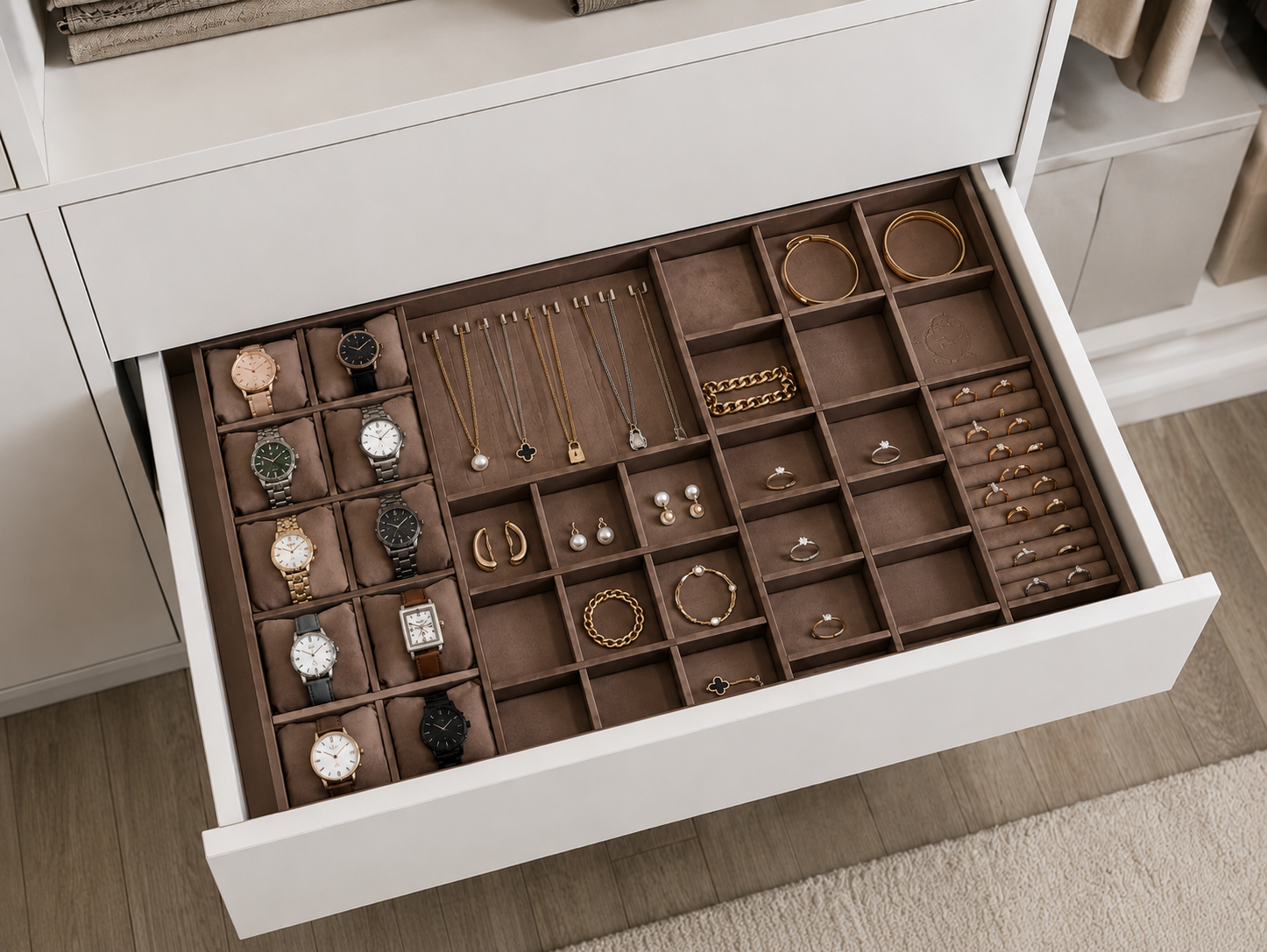
A wardrobe drawer can look spacious and still become difficult to use. Jewellery gets mixed with watches, belts take over empty corners, and smaller accessories disappear under larger pieces.
The problem is often not the amount of storage. It is the way that storage is divided.
A wardrobe organiser can give each category a defined place. The right layout can make jewellery easier to see, watches easier to access, and everyday accessories simpler to put away.
But one organiser does not work equally well for every wardrobe. Drawer dimensions, accessory collections and daily habits all affect the layout you need.
Some drawers work perfectly with a ready-made organiser. Others need a custom drawer organiser designed around the available space.
Here is how to decide what works for your wardrobe.
What makes a wardrobe organiser useful
A useful wardrobe organiser should make your existing storage easier to use. It should not simply add more compartments.
Start with the items you actually keep in the drawer. Jewellery, watches, belts, sunglasses and ties all have different shapes and storage needs.
A drawer filled with identical compartments may work for small accessories. It may not work as well for watches or belts that need more space.
A good organiser should help you:
- See different accessory categories without moving everything around.
- Keep frequently used items within easy reach.
- Give smaller pieces their own defined areas.
- Reduce unused gaps inside the drawer.
- Keep similar belongings together.
- Maintain the same layout after you have organised the drawer.
The internal space matters just as much as the organiser itself. A solution that fits the drawer properly can make better use of the available length, width and depth.
That is why measuring the drawer should come before choosing the organiser.
Should you choose a standard or custom wardrobe organiser
A standard organiser can be a practical choice when its dimensions already suit your drawer.
You may not need a custom solution if the organiser fits properly and its compartments match what you want to store.
A custom drawer organiser becomes more useful when the drawer has unusual dimensions or your collection needs a more specific layout.
For example, a single wardrobe drawer may need small sections for rings and earrings, medium sections for bracelets, and larger spaces for watches or sunglasses.
Here is how the two options differ:
| Feature | Standard organiser | Custom organiser |
|---|---|---|
| Dimensions | Fixed | Planned around the available space |
| Compartments | Predefined | Planned around your collection |
| Unusual drawer sizes | May leave unused gaps | Can be designed around the drawer |
| Mixed accessories | General layout | Category-specific layout |
| Layout flexibility | Limited | Greater flexibility |
| Wardrobe integration | Depends on fit | Planned around the existing space |
Neither option is automatically right for every drawer.
The better choice depends on your measurements, belongings and how you use the storage space.
The market also shows both approaches. Ebco offers dedicated wardrobe drawer organisers for different storage needs, while custom-organiser providers focus on designing around specific drawer measurements and requirements.
How to measure your wardrobe drawer correctly
Accurate measurements make a major difference when choosing a wardrobe organiser.
Measure the inside of the drawer, not just its external dimensions.
You need three measurements:
Length
Measure from the inside of one side of the drawer to the other.
Width
Measure the usable distance from the front of the drawer towards the back.
Depth
Measure the usable vertical space from the drawer base to the point where the organiser will sit.
Also look inside the drawer for anything that could reduce the available space.
Check for:
- Drawer runners
- Hinges
- Handles
- Internal fittings
- Raised sections
- Uneven surfaces
For a wardrobe drawer, even a small difference can affect the final fit.
If you are ordering a custom drawer organiser, share the internal measurements rather than relying on the wardrobe's listed or external dimensions.
Your original article correctly emphasises checking the usable space and internal fittings before planning the organiser.
What should you store in a wardrobe organiser
The best way to plan your wardrobe organiser is to start with your belongings.
Take everything out of the drawer and group similar items together. This gives you a clearer idea of how much space each category actually needs.
Jewellery
Jewellery often contains many small pieces that are easier to manage when separated. Jewellery trays can provide dedicated sections for rings, earrings, necklaces, bangles and bracelets.
You could create dedicated areas for:
- Rings
- Earrings
- Necklaces
- Bracelets
- Bangles
- Everyday jewellery
Smaller compartments can help keep these pieces separated instead of placing them together in one large section.
Watches
Watches need more individual space than many smaller accessories.
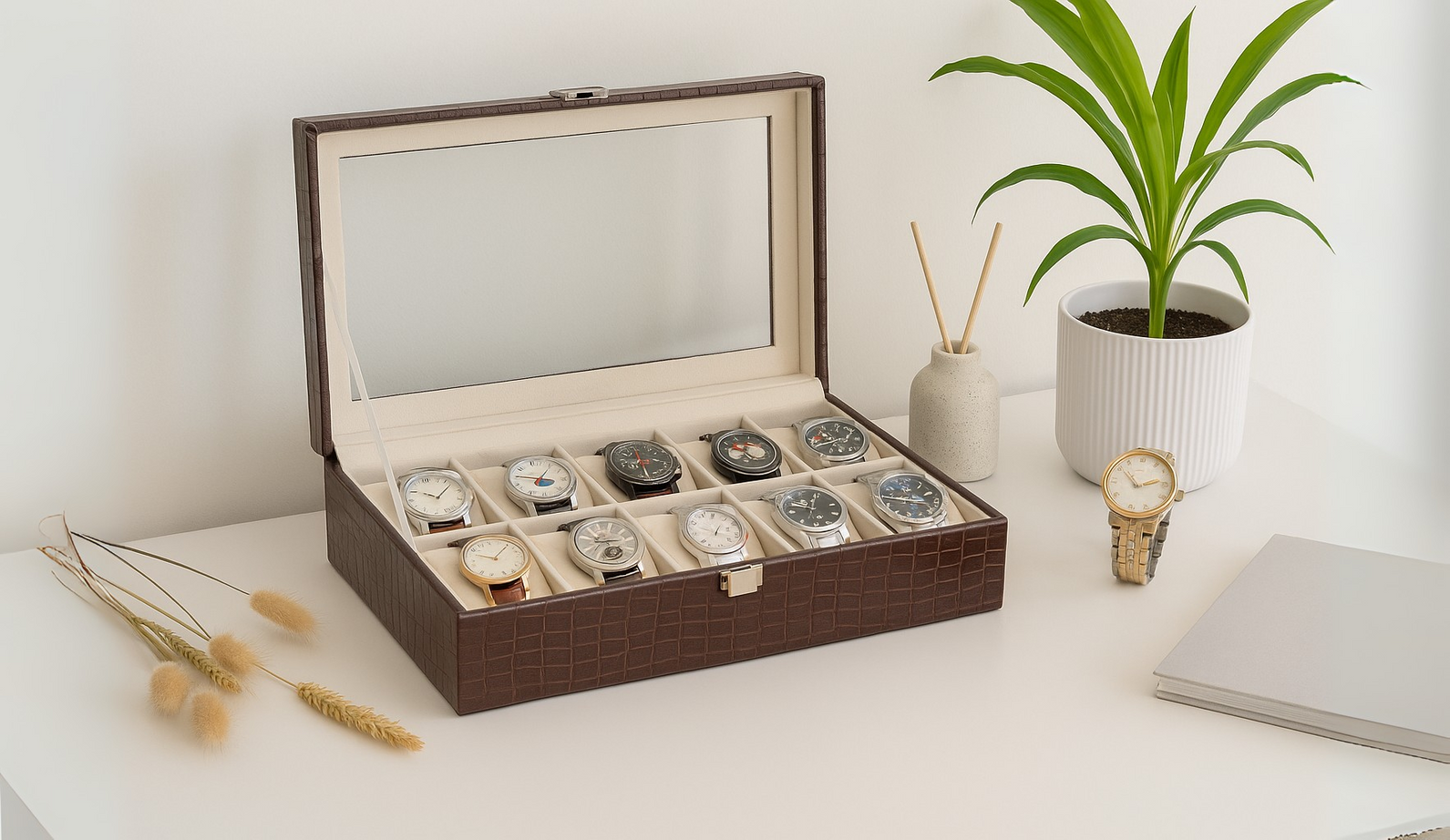
If you own several watches, individual sections can keep them separated and easier to view. Explore watch organisers designed for wardrobes, drawers and dressers.
A dedicated watch section can also sit alongside jewellery or other accessories within the same wardrobe drawer.
Belts
Belts usually need longer storage areas than jewellery.
A drawer layout can include longer sections that keep belts organised without forcing them into smaller compartments. For ready-made options, explore belt organisers designed for wardrobes and drawers.
Sunglasses
Sunglasses benefit from dedicated sections because each pair needs enough room to be removed without disturbing the others. Sunglass organisers can give each pair a defined space while keeping the collection easy to access.
The number of pairs you own should help determine how much drawer space you allocate to them.
Ties and pocket squares
Ties and pocket squares can share a dedicated accessory area when the drawer layout allows it.
The compartment size should match the way you fold or store them.
Smaller accessories
Cufflinks and other small personal accessories can use smaller sections that would otherwise become wasted space.
The goal is simple. Plan the compartments around what you own, rather than filling the drawer with identical sections.
How to plan the compartments around your collection
Before choosing the layout, look at the size and quantity of each category.
A jewellery collection may need many small compartments. A watch collection may need fewer, larger sections. Belts may need longer spaces, while sunglasses need individual areas.
Consider these factors before finalising the layout:
- Number of items in each category
- Size and shape of the items
- How often you use them
- How much space each category needs
- Drawer depth
- Available drawer area
- Visibility
- Ease of access
Think about your daily routine too.
If you wear the same watch every morning, placing it at the front of the drawer makes sense. If you rarely use certain accessories, they can occupy less accessible areas.
A custom layout gives you more freedom to make these decisions.
For example, one wardrobe drawer could have small jewellery compartments on one side, watch sections in the centre and longer spaces for belts or ties on the other.
The exact arrangement should depend on your collection.
When a custom drawer organiser makes sense
A custom drawer organiser is useful when a standard layout does not make good use of your drawer.
You may want one if:
-
- Your drawer has unusual dimensions.
- A standard organiser leaves large gaps.
- You have several types of accessories in one drawer.
- Your collection needs different compartment sizes.
- You want dedicated storage for specific items.
- You are designing storage for a dressing area or walk-in wardrobe.
- You want the organiser to work around existing drawer fittings.
The main benefit is control over the layout. A bespoke drawer storage solution lets you plan compartments around the available space and the items you actually use.
Instead of buying an organiser first and then deciding how your belongings should fit, you can start with the drawer and collection.
That approach is also reflected in the custom-organiser market. Krisani asks customers to provide drawer measurements and storage requirements before creating organiser sketches for approval.
Etsy's current custom-drawer marketplace also includes made-to-measure and personalised organisers across jewellery, kitchen, vanity and other storage uses.
For a wardrobe-focused solution, the same principle can be applied to jewellery, watches, belts, sunglasses and other personal accessories.
How a custom wardrobe organiser is created
A custom organiser should begin with the space, not the product.
A typical process can follow these steps.
1. Share your requirements
Explain where the organiser will be used and what you want to store.
2. Measure the available space
Provide the internal length, width and usable depth of the drawer.
3. Group your belongings
Identify the categories you need to store and roughly how many items belong in each.
4. Plan the layout
Decide how much space each category needs and where frequently used items should sit.
5. Confirm the requirements
Review the proposed configuration before production begins.
6. Create the organiser
The organiser can then be produced according to the agreed requirements.
This process keeps the storage plan connected to the actual drawer.
Krisani follows a similar measurement, requirement, design and approval process on its custom-organiser page.
How to organise a wardrobe drawer so it stays useful
Organising the drawer once is easy. Keeping it organised is what matters.
Start by removing everything from the drawer.
Then group similar items together. You may find that some accessories do not need drawer space at all.
After that, identify the things you use most often.
Place everyday jewellery, watches or accessories in sections that are easy to reach. Keep less frequently used items in areas that you do not need to access as often.
A simple process looks like this:
- Empty the drawer completely.
- Group similar items.
- Count the items in each category.
- Identify your most frequently used pieces.
- Measure the available drawer space.
- Plan the compartment sizes.
- Place everyday items where they are easiest to reach.
The layout should make putting things away just as easy as taking them out.
Your existing article uses a similar seven-step approach, so this keeps that useful idea while making it more concise.
Custom wardrobe storage for different spaces
Custom organisation does not have to stop at one wardrobe drawer.
The same approach can work across different areas of a bedroom or dressing space.
Bedroom drawers
A bedroom drawer can hold everyday jewellery, watches, sunglasses or other personal accessories.
Dressing areas
A dressing area may need several accessory categories in one location. Separate drawers can be planned for jewellery, watches, belts or other belongings.
Walk-in wardrobes
A walk-in wardrobe often combines hanging areas, shelves and drawers.
Clothing can use the hanging sections while smaller accessories stay in dedicated drawers.
Multiple drawers can also serve different categories instead of placing everything into one large storage area.
The principle stays the same: understand the available space first, then decide how each category should fit into it.
Your original article already covers these applications, including bedroom drawers, dressing areas, walk-in wardrobes and accessory storage.
Questions people ask about wardrobe organisers
What is a wardrobe organiser?
A wardrobe organiser is a storage solution that divides wardrobe space into sections for clothing, accessories or personal belongings. A drawer organiser can provide dedicated areas for items such as jewellery, watches, belts and sunglasses.
What is a wardrobe drawer organiser?
A wardrobe drawer organiser is designed to divide an existing wardrobe drawer into useful storage sections. The layout can be fixed for a standard product or planned around the drawer for a custom solution.
How do I measure a drawer for an organiser?
Measure the internal length, internal width and usable depth. Also check for drawer runners, hinges and other fittings that may reduce the available space.
When should I choose a custom drawer organiser?
Consider a custom drawer organiser when your drawer has unusual dimensions, standard products leave unused gaps, or your collection needs different compartment sizes.
Can a wardrobe drawer organiser store jewellery and watches?
Yes. A suitable layout can include smaller jewellery compartments alongside dedicated sections for watches.
Can I create a custom jewellery drawer in my wardrobe?
Yes. A wardrobe drawer can be planned as a dedicated jewellery storage area with compartments based on the types and quantity of jewellery you own.
Are custom organisers suitable for walk-in wardrobes?
Yes. Custom organisers can be planned for drawers within walk-in wardrobes, especially when you want dedicated storage for accessories.
What is the difference between a custom organiser and a standard organiser?
A standard organiser has fixed dimensions and predefined compartments. A custom organiser can be planned around the available drawer space and the items you need to store.
A wardrobe organiser should fit the way you use your space
A good wardrobe organiser should make your existing storage easier to use.
Start by measuring the drawer. Then group your belongings and understand how much space each category needs.
If a standard organiser fits those requirements, it can be a practical choice. If the drawer has unusual dimensions or your collection needs a more specific layout, a custom drawer organiser may give you greater flexibility.
At La Trove, custom organiser solutions can be planned around your drawer, wardrobe and accessory requirements. You can explore a custom wardrobe storage solution for jewellery, watches, belts, sunglasses, ties and other personal accessories.
Explore La Trove's custom organiser solutions and create a storage layout designed around your space and your collection.



Leave a comment
This site is protected by hCaptcha and the hCaptcha Privacy Policy and Terms of Service apply.